


Case study · DataRume
How a diligence data room became an on-chain asset with its own access token, deployed in four steps from the browser.
DataRume is the data-room product Exaflair built on its Skuchain engagement, alongside SecureTrade and Skucodes. Its own documentation puts it plainly: “a decentralized platform for secure, token-gated data sharing” that “utilizes Data NFTs to represent Data Rooms and Data Tokens to manage access control.” Files stay in DataRume-managed or the client's own S3; the room's manager contract is deployed and verified on Optimism mainnet.
- SubjectDataRume — the data-room product on Exaflair's Skuchain engagement
- MeasureA 4-layer stack over 2 networks (RumeNet, chain 600001; Optimism, chain 10), a 4-step deploy, and 2 contracts reading as verified on Optimism mainnet
- VersionDocs at v1.0.0 stable; the engagement is ongoing
Proof, before you scroll
Data-room lifecycle · selected state
- Initialize
- Assets
- Access
- Network
- Deploy
- Live room
Pick a state in the explorer under “What we built”. This strip and the Result table follow it.
Swipe the screen sideways to see all of it.
Engagement
- Subject
- DataRumeOn-chain access-controlled, auditable data rooms for enterprise diligence documents.
- Client / context
- Skuchain Inc.DataRume is one of three products on the same Skuchain engagement, with SecureTrade and Skucodes.
- Sector
- Web3 & blockchainEnterprise diligence: sensitive documents shared under an access record anyone party to it can check.
- Exaflair's role
- The engineering teamSenior full-stack blockchain engineers inside Skuchain's team, owning the build: architecture, contracts, the app, deployment and maintenance.
- Engagement
- OngoingExaflair engineers are still in the team, shipping on Skuchain's cadence.
- Networks
- RumeNet + OptimismRumeNet, a private L2 on chain 600001, is the primary platform; Optimism, chain 10, carries public provenance.
- Stack
In the client's words

Sunil Gopinath
Director of Engineering at Skuchain Inc.
during the engagement
during the engagement
“What stood out most was their ability to build cloud-native architectures, and scaling with strong project management practices and clear stakeholder communication. They consistently brought clarity and momentum to every engagement. Self-organized, and highly honest, they are people you can count on to follow through.”
Published testimonial, exaflair.com/portfolio/skuchain/case-study.
Context
A data room is only as good as the record of who opened it.
Enterprise diligence runs on documents that must be shared with named counterparties and no one else, and on being able to show afterwards exactly what was made available and to whom. DataRume's answer is to make the room itself an on-chain object: a Data NFT (ERC-721) represents the room, and a Data Token (ERC-20) minted per room, symbol DRUME, governs who may open it, with the files themselves held in object storage rather than on a chain.
The product's own summary of what it is for: “an auditable and secure environment for sensitive data exchange.”
Constraint
Enterprise users should not have to buy gas, or wait for a block.
Two constraints shape the whole architecture. The people who use a diligence room sign in with an email address, not a seed phrase — so the platform bridges a Web2 identity to a wallet, and funds that wallet itself the first time it connects, “to subsidize enterprise usage costs” in the docs' words. And nobody will accept a document list that takes a block to appear, so the architecture is, again in its own words, “designed to decouple user experience from blockchain latency.”
- Web2 identity on Web3 railsPasswordless email sign-in and wallet connect have to resolve to one profile, so an enterprise user can operate on-chain without changing how they log in.
- Chain latency versus spreadsheet speedRooms, files and transactions have to read instantly while still settling on a network, which is why persistence and sync sit in their own layer.
What we built
A room that starts as a draft and ends as a contract with an access ledger.
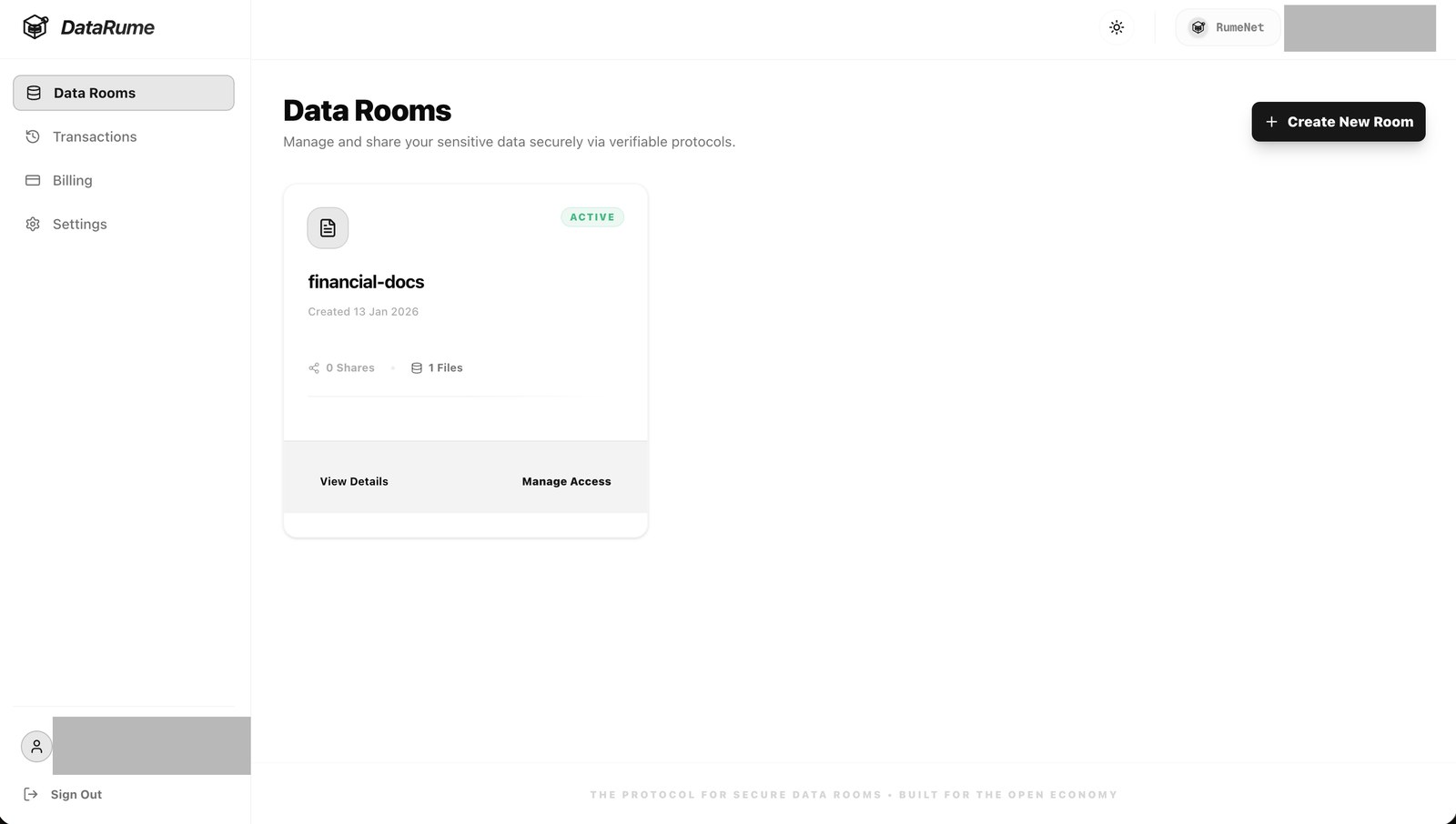
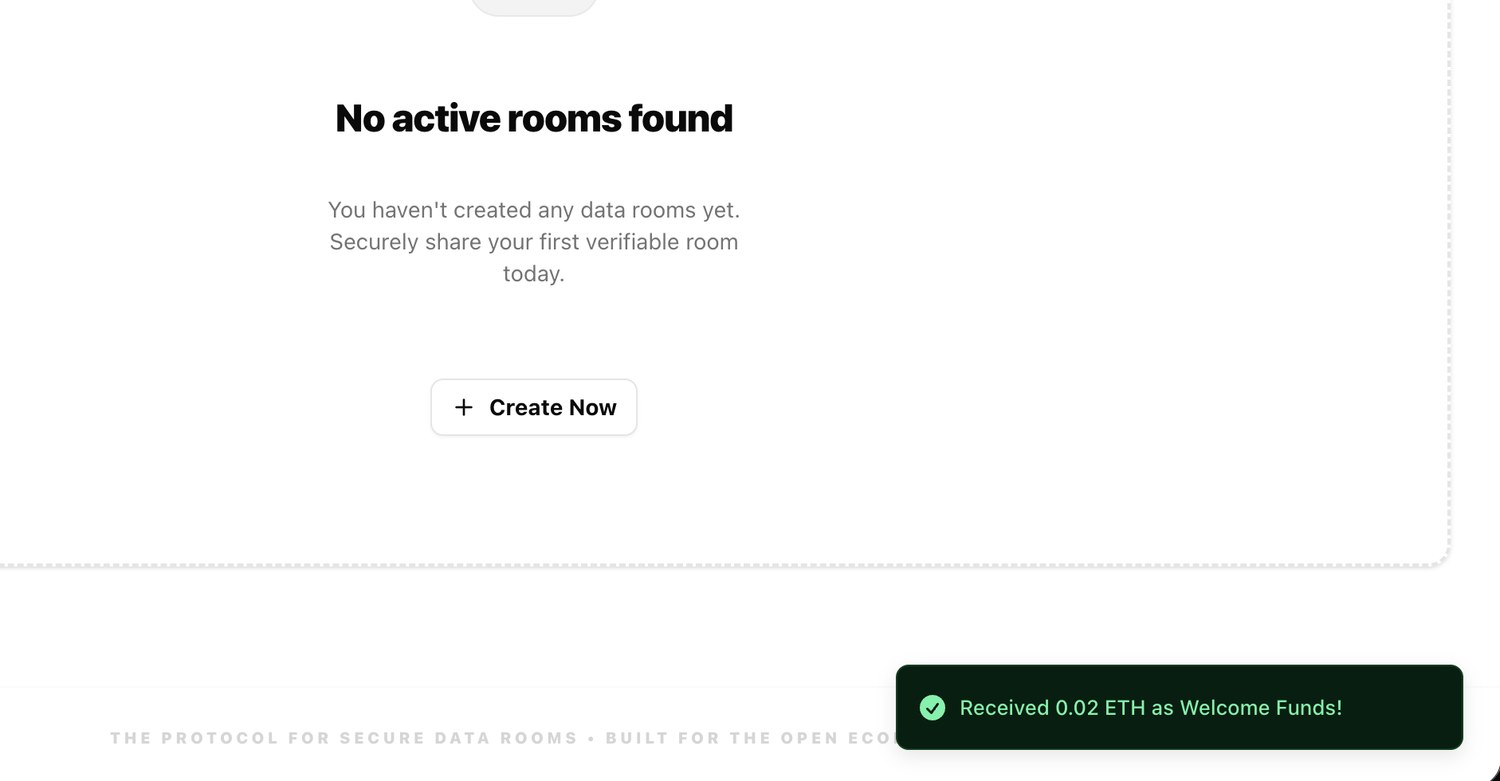
A DataRume room is not created by an administrator filing a ticket. The owner names it, chooses where the files live, sets how many times it may be opened and for how long, picks the network, sees the exact fee and gas, and signs once. What comes back has its own Data NFT (ERC-721) and Data Token (ERC-20) addresses, plus a storage ledger and a holder list. Step through it below — the screen, the panel, the state strip in the hero and the Result table all follow suit.
Data-room lifecycle explorer
Use ← → , Home and End, or click a state. Screens are DataRume's own captures from the platform documentation.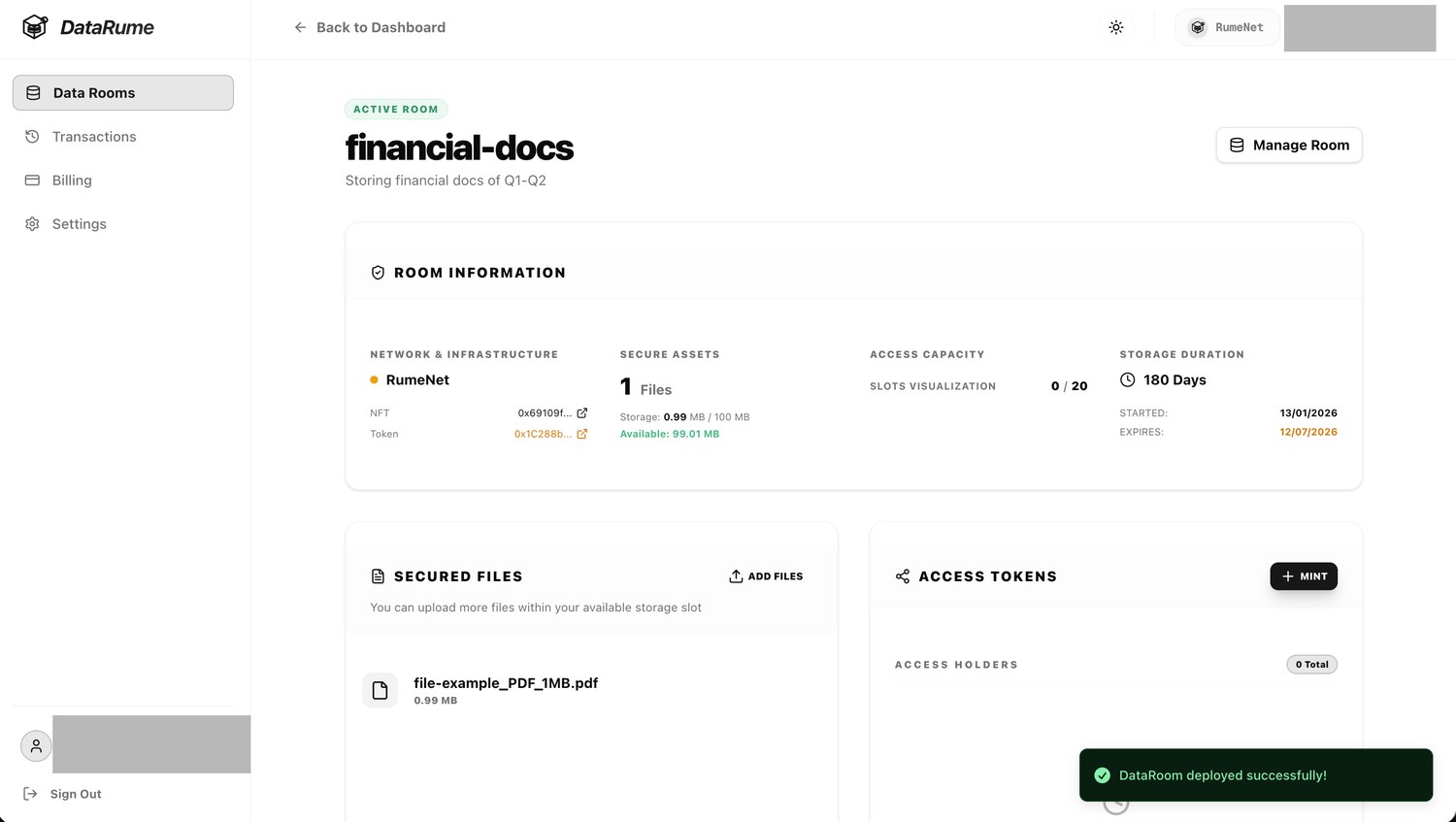
Swipe the screen sideways to see all of it.
Room details, active. The room shows its own NFT and access-token addresses, its storage and slot ledger, and who holds access.
6 / 6
Live room
- Who acts
- Owner mints access; holders burn a token to view
- Where
- RumeNet in this capture; Optimism for public provenance
- In the capture
- Active room · NFT and Token addresses linked out · Slots 0 / 20 · 0.99 MB of 100 MB
What happens
The deployed room reports itself: which network it is on, the addresses of its Data NFT (ERC-721) and its Data Token (ERC-20), how much storage and how many access slots are used, and the holders who can open it. Access is minted from here.
Named in the docs at this step
- Data NFT (ERC-721)
- Data Token (ERC-20) · DRUME
- Blockscout
Exaflair built
The room-details screen, the minting path for access, and the indexer reads behind the holdings and history.
Exaflair built the platform: the contracts, the Next.js application, the storage and indexer integrations, the infrastructure and the maintenance since. Step names, network names, chain IDs, contract names and token symbols on this page are from DataRume's own documentation; the two contract addresses and their verified status are from the Optimism explorer. financial-docs and the file in it are the documentation's own demo content.
-
Architecture · from the docs
The four-layer stack
The documentation's own decomposition, in its order.
- InstantDBPersistence and real-time sync, offline buffering, and a graph schema linking users, rooms, files and payment transactions.
- Blockchain (EVM)RumeNet for the platform itself, Optimism for public provenance; contracts for asset creation, transfers and inventory.
- Blockscout APIA custom indexer integration for holdings and history, syncing in the background.
- Next.js 15App Router and Turbopack, Tailwind CSS 4, Wagmi and RainbowKit for the wallet layer.
Layers and their contents as the platform's Architecture page lists them. -
Documentation · v1.0.0 stable
The platform docs
Fourteen sections from Platform Overview to Web3 & Networks, including the terminology the rest of this page quotes.
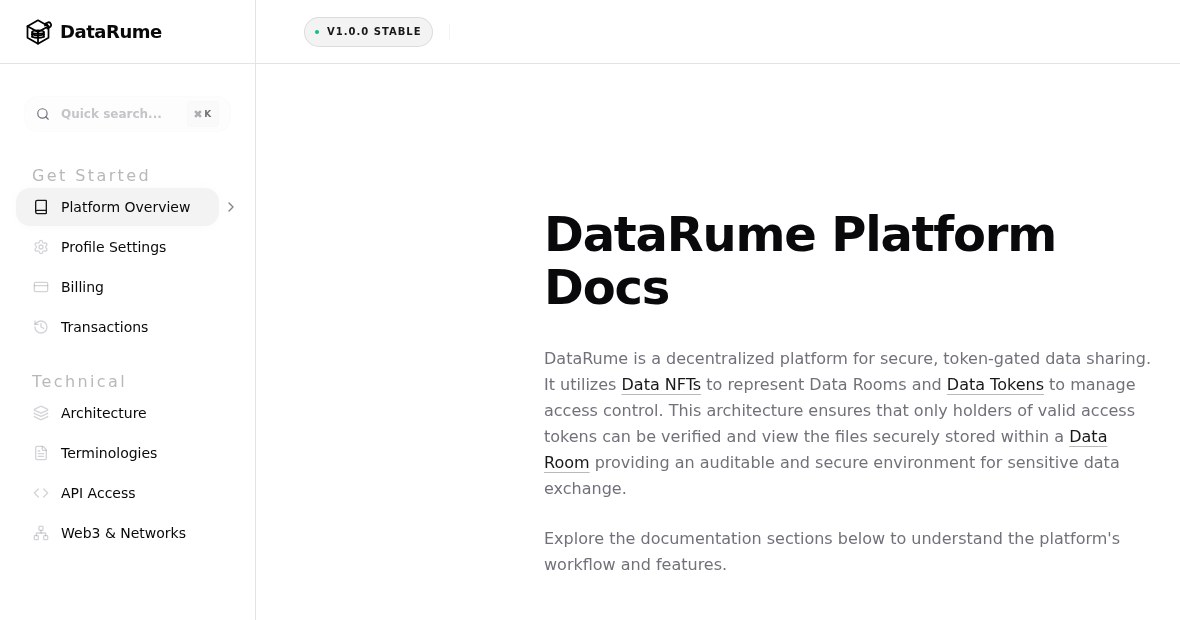 The DataRume platform documentation, v1.0.0 stable.
 -
On-chain · Optimism mainnet
The room manager
An ERC721Factory deploys a DatarumeManagerContract per room; on Optimism mainnet the manager sits behind a proxy, and both halves read as verified on the explorer.
ERC1967Proxy0x5D4E9057faBc9453879795b1fc0DA6e2B60Da119 DatarumeManager, its implementation0x0F404d59997462e8a97a8D86031ee0fb6581E747Both addresses report is_verified on the Optimism explorer, checked 10 Sep 2026.
What we did not build
Boundaries, so the credit lands where it belongs.
Skuchain owns the product, the diligence domain rules and its client relationships. Exaflair built to that direction, not around it.
No new L1. RumeNet is a private L2 and Optimism is the public one, which keeps the surface area small and the provenance readable on a public explorer.
No obligation to hand over the documents. A client can point a room at their own self-hosted S3 bucket, with their own credentials, and DataRume never holds the files.
No mobile app, and no brand identity for DataRume: the product ships an unmodified neutral theme and a single line-art mark, which is why this page's own accent is achromatic.
Result
What can be checked today.
- 4layersin the platform stackInstantDB sync, EVM contracts, Blockscout indexer, Next.js 15 front end
- 2networksone private, one publicRumeNet, chain 600001, private; Optimism, chain 10, public provenance
- 2contractsverified on Optimism mainnetThe ERC1967Proxy and its DatarumeManager implementation, both verified on the explorer
- 4stepsfrom draft room to deployed roomAssets & storage, access slots, network, deploy — the wizard in the product
Before and after, per state
The row for the state selected in the explorer is highlighted; clicking a row selects that state. “Usual practice” is how a document room of this kind is normally run, for orientation — it is not a description of an earlier Skuchain system.
| State | Usual practice | In DataRume |
|---|---|---|
| Initialize | A folder is created in someone's drive and named in whatever convention that person uses. | The owner names the room and describes it; a draft exists before any transaction is signed.draft room · DataNFT and DataToken deployed later |
| Assets | Files are copied into a vendor's storage, wherever that is. | The owner picks DataRume-managed S3 or their own self-hosted bucket, then queues the files.Storage provider · Self-Hosted (Your S3) |
| Access | Access is a list of email addresses, revised by hand, with no ceiling and no expiry. | Access capacity is a number of slots and the room has a storage duration, both set before deploy and renewable later.20 slots · 180 days · 2 × 90-day cycles |
| Network | The question does not arise: the vendor's database is the only place the record can live. | The owner chooses the private network or the public one, per room, at deploy time.RumeNet · private | Optimism · public |
| Deploy | Cost appears on a seat licence or an invoice, after the fact. | Platform fee and estimated gas are itemised on screen, and the room is created by one signed transaction.startOrder · executeOrder |
| Live room | An access log lives inside the same vendor that controls the files. | The room, its access token and its holders are on-chain objects, readable from an explorer rather than from the vendor.Data NFT (ERC-721) · Data Token (ERC-20, DRUME) |
Selected in the explorer: Live room — the room, its access token and its holders read from the chain, not from a spreadsheet.
Closing quote
“I would work with them again in a heartbeat.”
Sunil Gopinath, Director of Engineering at Skuchain Inc. during the engagement.
What's next